Every capsule wardrobe post promises a version of the same thing: a small number of pieces, an impressively large number of outfits, and a vague gesture at “endless combinations” in between. The gesture is the problem. Twelve pieces do not produce endless outfits, they produce a specific, countable number, and that number depends entirely on which twelve pieces you pick. Work the actual math and you get something more useful than a slogan: a way to check, before you buy anything, whether a capsule is going to earn its keep.
What goes into the 12
To make the math concrete, here is one real 12-piece capsule, built the way most working capsules actually shake out: a few tops, fewer bottoms, one dress, two layering pieces, and two pairs of shoes.
4 tops (a white shirt, a fine knit, a plain tee, a silk blouse), 3 bottoms (dark denim, tailored trousers, a midi skirt), 1 dress, 2 layers (a blazer, a cardigan), 2 pairs of shoes (loafers, minimal sneakers).
Nothing in this list is unusual or expensive to assemble. That is deliberate: the point of the exercise is that the outfit count comes from how the pieces relate to each other, not from how many of them you own.
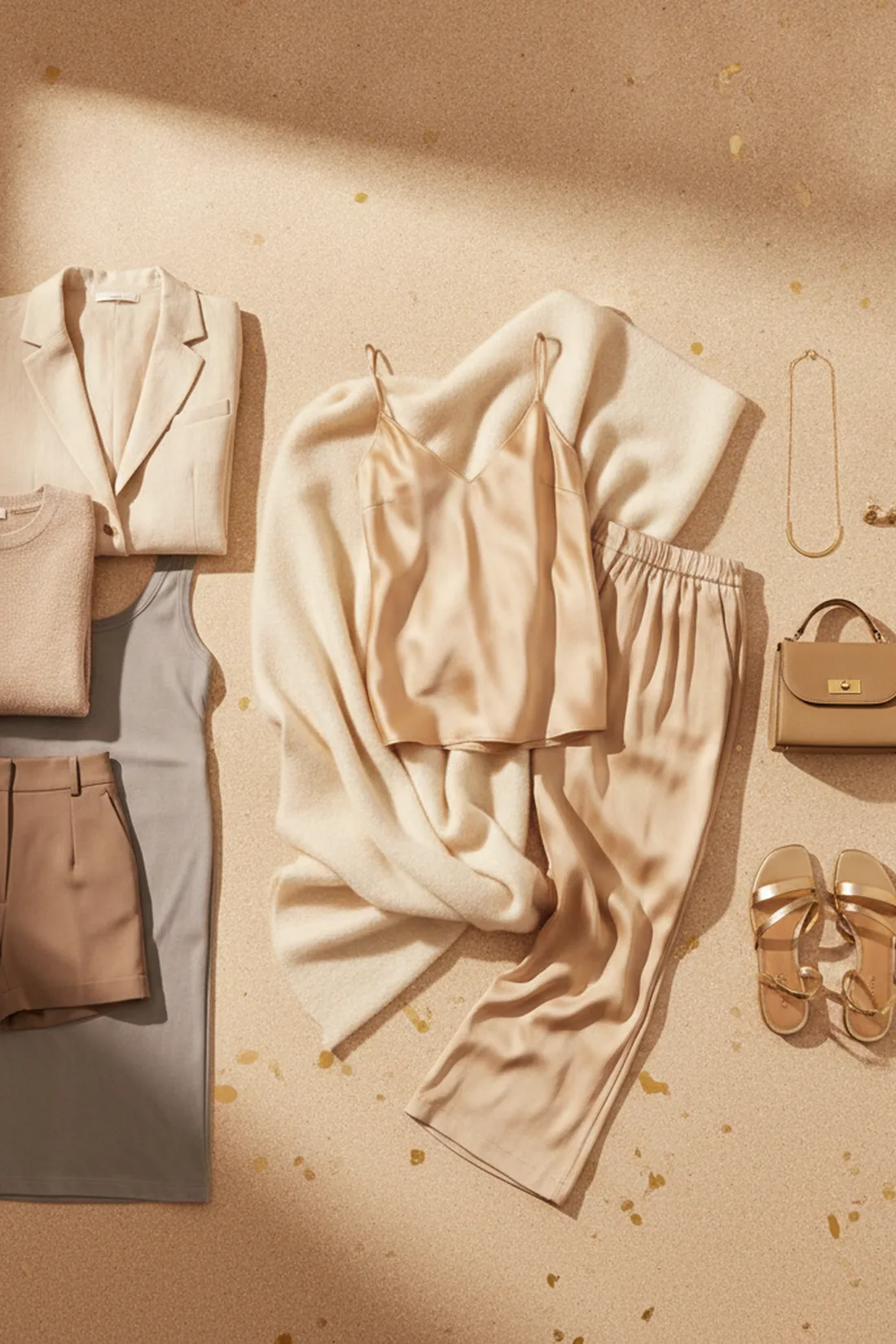
Image: Aurea studio.
The math, step by step
Start with the two categories that combine most directly: tops and bottoms. Four tops against three bottoms gives 4 x 3, or 12 base pairings, before a single layer or shoe enters the picture.
Each of those 12 pairings can then be worn three ways: on its own, under the blazer, or under the cardigan. That is not “plus 2,” it is a multiplier, because every one of the 12 base pairings gets its own blazer version and its own cardigan version. Twelve pairings times three layer states comes to 36 distinct top-and-bottom outfits.
The dress works the same way, just without a bottom to pair against. Worn alone, under the blazer, or under the cardigan, it produces 3 more outfits.
Add those together: 36 from the tops and bottoms, plus 3 from the dress, comes to 39.
Shoes are deliberately left out of that multiplication. Both pairs here dress an outfit up or down by roughly the same amount, so swapping one for the other changes the finish of a look without changing what the look fundamentally is. You could double the count to 78 by treating each shoe choice as its own outfit, and that would not be wrong, exactly, it would just be counting something different: styling variations rather than genuinely distinct outfits. Thirty-nine is the honest number for pieces that actually change the outfit’s identity.
Which pieces are doing the multiplying
Look back at the arithmetic and one thing stands out: the two layering pieces are responsible for nearly two-thirds of the final count. Without the blazer and the cardigan, this capsule would produce 12 top-and-bottom pairings plus one dress, or 13 outfits total. Add the layers back in and the count nearly triples to 39. That is the real lesson of the math, not the specific total: a layering piece that goes over almost everything else in the capsule is worth more, outfit for outfit, than a fourth top or a fourth bottom would be.
This is also why a single well-chosen blazer keeps showing up across completely different kinds of guidance. It is the same piece doing the same multiplying job whether you are building a five-day work capsule or dressing for a smart casual dinner: one polished layer, worn over a relaxed base, instantly makes more outfits look considered rather than assembled. A cardigan does the same multiplying job with a softer, more casual read, which is why the capsule above carries one of each rather than two versions of the same effect.
Where this math breaks down in real closets
The arithmetic above assumes every piece can pair with every other piece in its category, and that assumption is exactly where most real capsules fall short of their promised count. A silk blouse in an unusual print will not sit quietly under a blazer the way a plain white shirt does. A trouser in a color that clashes with your dress means one of your “3 bottoms” effectively behaves like 2 for counting purposes, because the third pairing is never one you would actually wear.
Color is the most common place this shows up. If your 4 tops and 3 bottoms are not built around a small, coordinated set of core colors, the real number of pairings you would actually wear can end up closer to half the theoretical 12 than the full amount. This is the same reason a capsule built around 3 core colors tends to outperform a capsule built around whatever happened to be on sale: the arithmetic only pays off if the pieces were chosen to combine, not just to coexist in the same closet.
The other common failure is buying a second version of a piece you already have instead of a piece that multiplies differently. A second pair of dark denim adds almost nothing to the count above, because it duplicates a bottom that already pairs with everything. A second layering piece, in a genuinely different silhouette or weight, adds far more, because it multiplies against every top-and-bottom pairing you already own.
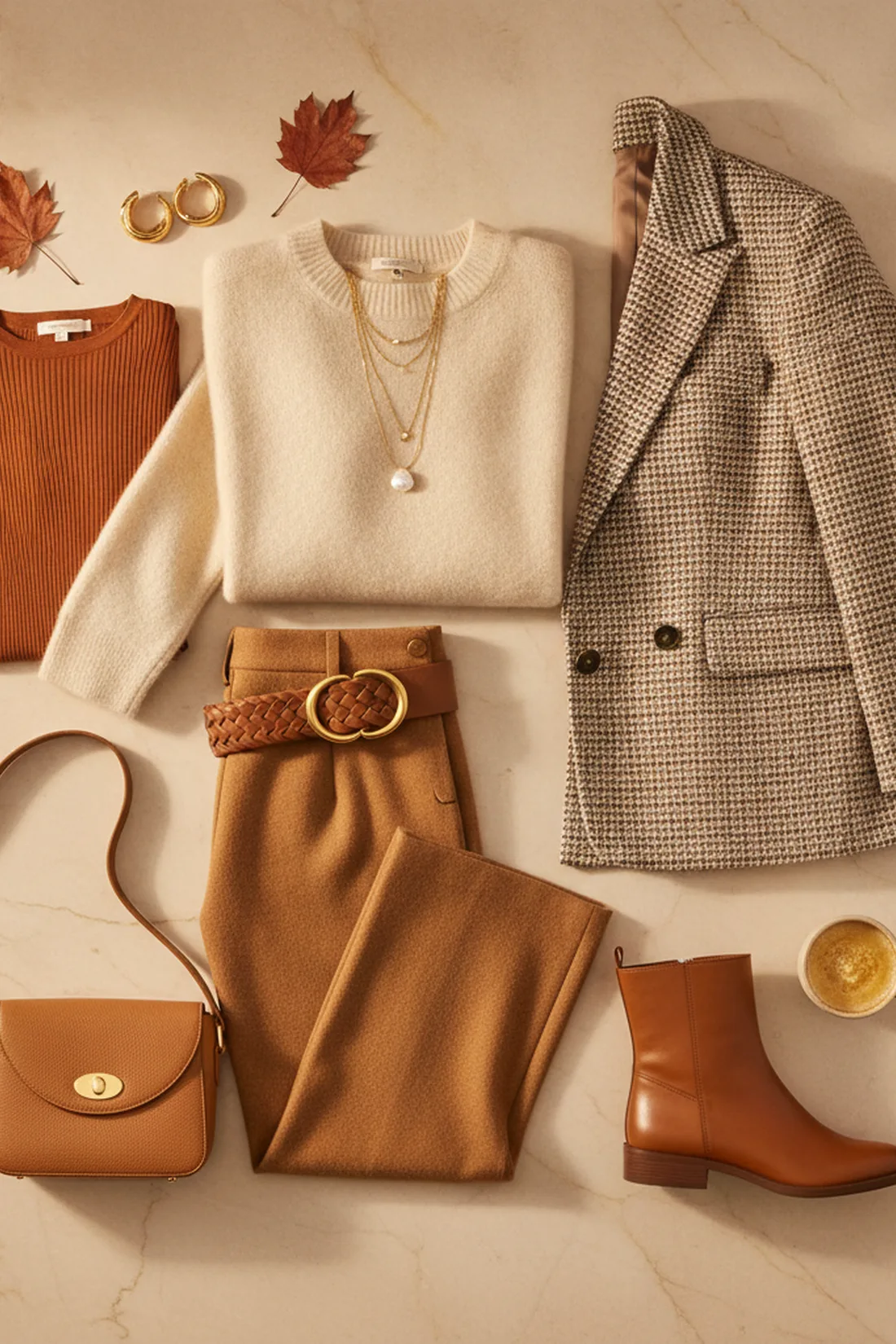
Image: Aurea studio.
Building your own 12-piece capsule
If you are building one of these from scratch, work in the same order the math does. Pick your bottoms first, since they are the most restrictive category and the hardest to make work with everything else. Choose tops next, checking each one specifically against every bottom you have already picked, not just against your favorite one. Add a dress if you wear them, since it is close to a free outfit category once you already own the layers to go with it. Layering pieces come last, and they should be chosen for maximum spread: one polished, one relaxed, so that every earlier pairing gets two genuinely different upgraded versions rather than two similar ones.
Shoes and accessories round out the capsule, but as the math above shows, they are not where the outfit count comes from. Spend your piece budget on the categories that multiply, and the “endless combinations” promise stops being a slogan and starts being a number you actually worked out yourself.
The concept has more history behind it than the current wave of capsule wardrobe content usually credits. The term itself appeared in American fashion writing as early as the 1940s, describing a small set of garments designed to be worn together. London boutique owner Susie Faux revived it in the 1970s around a core of timeless, seasonless pieces, and Donna Karan brought it to a mass audience in 1985 with her “7 Easy Pieces” collection, built on exactly the same idea this math describes: a small set of pieces designed from the start to recombine.
Whatever twelve pieces you choose, the test is the same one this whole exercise runs: does a new piece multiply against what you already own, or does it just sit next to it. Run the arithmetic before you buy, and a capsule wardrobe stops being a matter of faith.
Questions, answered
Does the outfit count change if I add more shoes?
Not by much, and that is the point. Shoes finish an outfit rather than define it, so adding a third pair gives you more comfort options but does not meaningfully multiply your outfit count the way an extra top or a second layering piece does.
Do I need exactly 12 pieces for this to work?
No, 12 is a useful, tested size, not a rule. The same arithmetic applies at 10 pieces or 15: what matters is the ratio of tops to bottoms to layers, not the total number.
What if two of my pieces are the same color?
Two pieces in the same color still count as two pieces mathematically, but they will not always read as two distinct outfits, since color repetition is the fastest way for a capsule to start looking smaller than it is. Spreading your core colors across categories protects the real count.
Should I count dresses the same way as tops and bottoms?
Treat a dress as its own outfit category rather than folding it into your top or bottom count. It still benefits from layering pieces the same way a top-and-bottom pairing does, it just does not multiply against your bottoms.